The myths of China bashers: The oppressed Minorities

I never shared the hystery of western media and politicians about the oppression of ethnic and religious minorities in China. Against this were my own observations: In 2019 I was living near the Guangzhou Mosque. Once I stepped into the Muezzin and started a discussion with him and he denied any restriction of religious activities. My Chinese friends get irritated mentioning the “Oppression of minorities”. My wife says: they are even privileged, i.e with reserved university places. If a mixed couple has a child, they are running to register it as a minority.
Minorities in China
This is not just about Tibet and Xinjiang! There are 55 recognized minority groups in China of which the biggest are the Zhuang in Guangxi province (16-18millions). There are around 11.5 million Uyghurs, the original population of Xinjiang (the 4th biggest group of Minorities and on the 8th position (for population size) are the Tibetans with about 7 million people. Overall the minority population is about 111 million, which seams a lot, but it is only 8.85 % of the population. The minorities are living often in scarcely populated parts like Xinjiang. The Han majority lives in the crowded areas. so there is migration and now often Han people are outnumbering the minorities in their own area. Consider Xinjiang, one of China’s five autonomous regions—provinces granted, greater latitude to manage their own affairs. Its total population is approximately 23 million. Yet, of these, only around 11 million are Uyghurs. The Uyghurs are thus a demographic minority within their own province.
The official position of the Chinese government (expressed by deepseek)
Regional Ethnic Autonomy: This is the core policy. China has established 5 Autonomous Regions (Xinjiang, Tibet, Inner Mongolia, Ningxia, Guangxi), 30 Autonomous Prefectures, and 120 Autonomous Counties. These areas have, in theory, certain rights to self-governance, including the use of local languages and the development of local culture.
- Affirmative Action (Preferential Policies):
- Education: Minority students receive bonus points on the national college entrance exam (Gaokao). There are universities specifically for minority groups.
- Government Jobs: quotas exist to ensure minority representation in government and civil service.
- One-Child Policy: This policy was historically much more lenient for ethnic minorities, allowing them to have two or more children.
- Language Rights: Minorities have the right to use and develop their own languages. Bilingual education (local language + Mandarin) is promoted in minority areas. You will see street signs, public notices, and sometimes TV/radio broadcasts in languages like Tibetan, Uyghur, Mongol, and Yi.
- Cultural Promotion: The state often promotes and funds minority festivals, dances, music, and traditional crafts as part of China’s intangible cultural heritage. This can be a double-edged sword, sometimes leading to commercialization or “folklorization” for tourism.
- Economic Development: Significant state investment is directed into infrastructure (roads, railways, airports) in minority regions, which are often less developed. The official goal is to reduce poverty and integrate these regions into the national economy.
Impressions from a Tibetan Prefecture
My September holidays this year brought me into a piece of Tibet. Not Tibet proper, but in the North of Yunnan an autonomous Tibetan Prefecture., the Diqing Tibetan Autonomous Prefecture in Yunnan .. What you are seeing is flourishing culture of the Tibetan traditions. All street signs are in two languages. People dress in traditional dresses. There is all the noise and all the fragrance that we are expecting from Tibetan culture. Spoken Tibetan is everywhere the overwhelming cultural impression one receives is not Chinese; it is distinctly Tibetan.

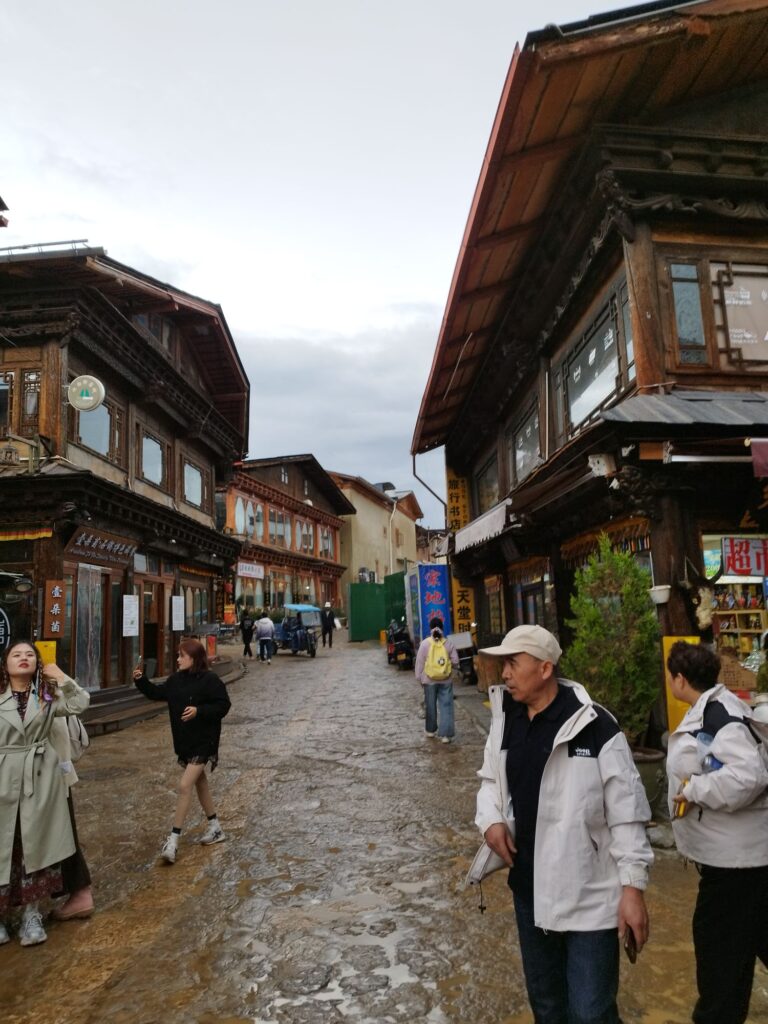
There are about 3.5 million inhabitants in Tibet, but there are 7 million Tibetans in China, more or less. So, this is not a question of Tibet, but a question of Tibetans. And they are free to practice Tibetan Buddhism and encouraged to preserve Tibetan culture, they are not free to ask for Tibet’s independence.
Minority “Oppression”?
Oppression exists, but oppression is not against minorities, but against people who question the integrity of the Chinese state and for people who do not acknowledge the rule of the Communist Party. But that’s not against minorities. That is against everyone. The treatment of minorities in prison is not different from the treatment of Chinese people and it is not nice
I cannot deny the existence of labour camps in Xinjiang (because I don’t know) at example. But inmates there were not because of their being Muslims nd Uighurs , but because of connections to opposition groupss which arre askin for independence of Xinjiang.
This repression started with some terroristic acts from the s ide of some islamic separatist Xinjiang groups. But the main reaction of the central governemtn was not repression, but a flow of Billions of RenMinBi into Xinjiang. Xinjiang is on the way to transform from a desert into a high tech garden landscape, showing the advantage of belonging to China.
If you go to Russia, there you can see what it means, minority oppression. The young folks of the Siberian and the Caucasus minorities are all sent to Ukraine for being slaughtered, whereas the kids of the Russian ruling ethnicity stay in St. Petersburg and Moscow and don’t go to the war.
.Right of secession?
There is a historical question of the legitimacy of China’s incorporation of Tibet and Xinjiang in 1949-1950. Yet, to endlessly revisit this is of little practical import. By such a standard, one could problematize the existential rights of many European states born from conquest and treaty. Xinjiang and Tibet could not find better luck than to be part of the PRC. Poor Tibetans were half slaves under the monk rules. Another Somethingstan in the place of Xinjiang would only destabilize and impoverish the region.
I have no sympathy for new states, but advocate the dissolution of the existing into Regions and Metropolitan areas with the right but not the obligation to diversity. In this regard, we in Europe and the USA are not in a better position than China. Instead we have another good opportunity to shut our judging mouth and to study other cultural developments, what does not mean to copy and to appreciate.